
Introducing chores can feel oddly dramatic for something as small as putting socks in a basket.
One minute you are calmly suggesting that everyone helps the household run. The next, a child is lying sideways on the sofa claiming that clearing a plate is “basically impossible,” and you are wondering whether the laundry pile has developed its own weather system.
The good news: chores do not have to begin with a family fight. A calmer start usually comes down to three things: small steps, visible expectations, and teamwork language. The aim is not to turn kids into tiny employees. It is to help everyone understand that a home works better when the people who live there gently pitch in.
Here is a practical way to introduce chores without making the whole thing feel like a lecture with a mop attached.
Start with the why, but keep it short
Kids do not need a fifteen-minute speech about responsibility before they wipe a table. In fact, the longer the speech, the more likely everyone forgets the table exists.
Try a simple explanation:
“We all live here, so we all help in small ways.”
That is enough. It frames chores as teamwork, not punishment. It also avoids the common trap of making chores sound like something kids must do because adults are exhausted, annoyed, or keeping score in their heads.
Good “why” language sounds like:
- “This is how we help each other.”
- “Small jobs keep the house easier for everyone.”
- “We are practicing being part of the team.”
- “When everyone does a little, nobody has to do everything.”
Less helpful language sounds like:
- “You never help around here.”
- “I should not have to ask.”
- “Because I said so.”
- “If you do not do this, no fun for anyone.”
You might feel those last ones in your bones on a hard day. Fair. But as an opening move, they tend to turn chores into a power struggle instead of a habit.
Pick tiny chores first
When a family is starting or resetting chore habits, go smaller than you think. “Clean your room” is not one chore. It is a vague expedition with emotional hazards, mystery cups, and possibly one missing library book from last term.
Tiny chores work better because they have a clear finish line. A child can see what to do and know when it is done.
Good starter chores include:
- Put shoes by the door
- Clear your plate after a meal
- Put dirty clothes in the basket
- Match clean socks
- Water one plant
- Put books back on the shelf
- Feed a pet with grown-up guidance where needed
- Wipe the table after snack time
These chores are not glamorous. That is the point. The first goal is not to overhaul the house. It is to build the feeling of, “I can help, and my help counts.”
If a chore keeps causing confusion, split it into smaller pieces. “Tidy the living room” might become:
- Put cushions back on the sofa.
- Put cups in the kitchen.
- Put toys in the basket.
- Check the floor for anything that will attack bare feet later.
Specific beats grand every time.
Make the list visible
Invisible chore systems are where good intentions go to nap.
If the list only lives in a parent’s head, kids cannot learn to check it. If it only lives inside one phone, it is easy for everyone else to ignore. If it is on a piece of paper hidden under school letters and a takeaway menu, it may technically exist, but so does Atlantis.
Put the list where family life happens: kitchen counter, fridge, hallway, breakfast table, or another shared spot people naturally pass.
A visible list can be:
- A whiteboard
- A simple paper chart
- A laminated checklist
- A magnetic board
- A tablet in a shared space
- A shared digital choreboard
The tool matters less than the visibility. Everyone should be able to answer three questions without asking a grown-up:
- What needs doing?
- Who has helped?
- What is already done?
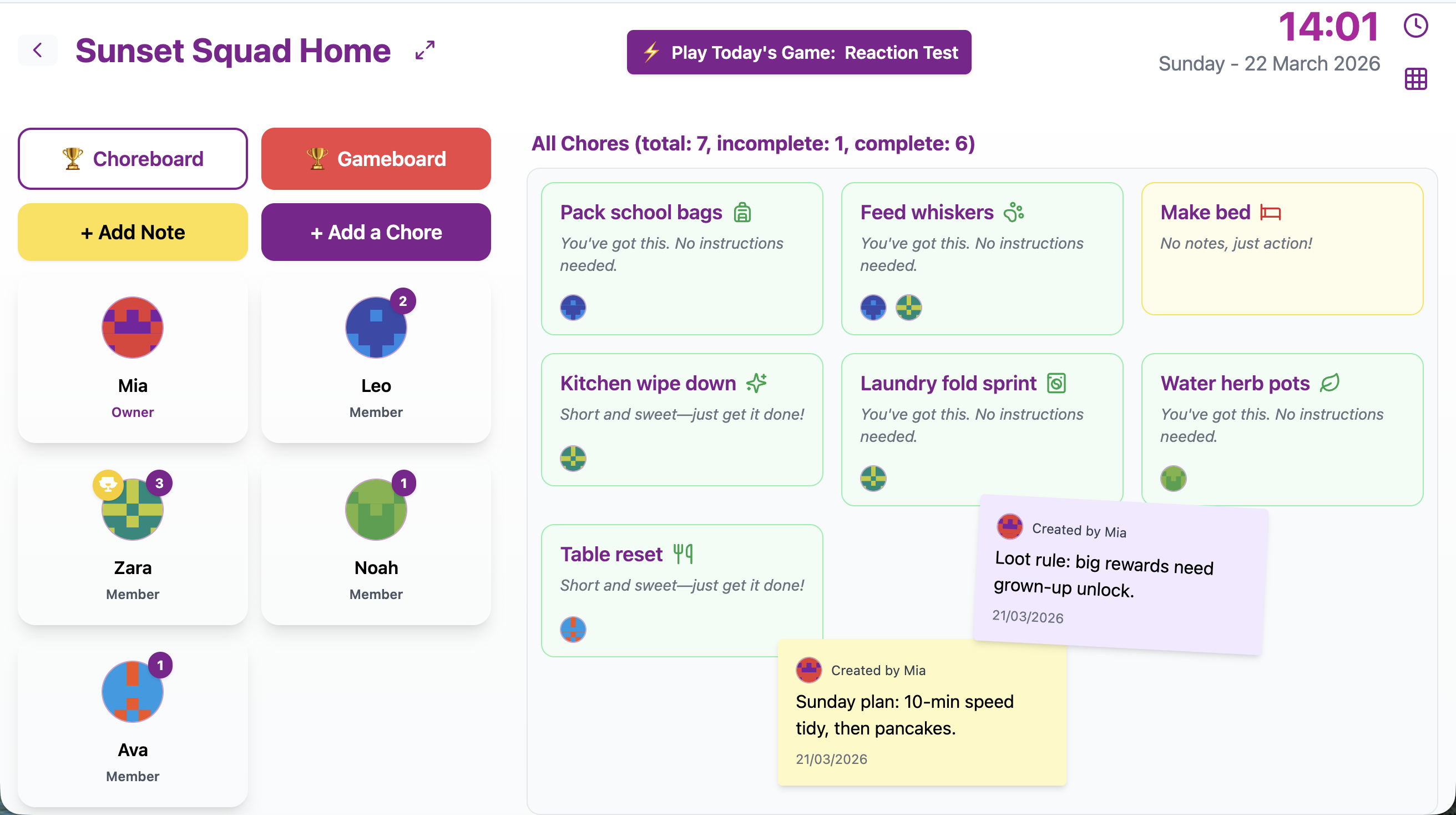
A shared home screen or visible list helps chores become part of the room, not just part of one person’s memory.
Use teamwork language, not blame language
The words around chores matter. A lot.
If chores are introduced as “things you are failing to do,” kids often defend themselves before they even begin. If chores are introduced as “small ways we help the home,” there is more room for cooperation.
Try swapping blame for teamwork:
| Instead of saying | Try saying |
|---|---|
| ”You made this mess." | "Let’s get this area reset." |
| "Why do I always have to ask?" | "Check the list and choose your next small job." |
| "You are being lazy." | "Starting is the hard bit. Pick the two-minute job first." |
| "Your sibling did more than you." | "Everyone is helping in a way we can see.” |
This does not mean pretending mess is magical or that adults never get frustrated. It means choosing language that points everyone toward the next useful action instead of the next argument.
Praise effort quickly
Praise does not need to be huge. In fact, big dramatic praise can feel strange if the chore was “put spoon in sink.” Quick, specific recognition works better.
Try:
- “Thanks for doing that without a reminder.”
- “That helped the kitchen feel calmer.”
- “Good reset. That took two minutes and made a difference.”
- “I noticed you came back and finished it.”
- “Nice teamwork.”
Specific praise teaches kids what mattered. It also helps adults notice effort before scanning for the next unfinished thing. That shift can change the whole feeling of chore time.
This is where visible progress helps. A chart, whiteboard, or shared choreboard gives everyone a simple way to see that effort happened. It reduces the classic “but I did help!” debate, which is rarely anyone’s finest family moment.
Add a gentle rhythm
Chores are easier when they attach to moments that already exist. A random chore request at 5:47 p.m. can feel like an ambush. A small reset after breakfast or before screen time feels more predictable.
Useful chore rhythms include:
Morning mini-reset: Plates cleared, pyjamas away, school bag by the door.
After-school landing: Shoes away, lunchbox emptied, one quick shared-space job.
Before-screen tiny habit: One two-minute chore before games, TV, or tablet time.
Evening reset: Table cleared, surfaces wiped, living room returned to a state that will not frighten tomorrow’s you.
Start with one rhythm. Not four. Four new routines at once is how a helpful idea becomes a family improvement project with too many meetings.
Let kids choose sometimes
Choice reduces resistance. It does not mean children run the household like tiny consultants with clipboards. It means offering controlled options.
Try:
- “Do you want to clear plates or wipe the table?”
- “Pick one job from the board before we go out.”
- “Do you want the two-minute job or the slightly bigger one?”
- “Should we do the kitchen reset before or after your snack?”
Choice can be especially useful for kids who dig in when they feel ordered around. You are still holding the boundary: everyone helps. But you are giving them a little ownership over how they start.
For more ideas around matching chores to age and ability, see our guide to age-appropriate chores for kids.
Keep competition light, if you use it at all
Some families love a friendly scoreboard. Some kids will absolutely sprint toward a gold medal. Others will treat competition like someone has released a goose into the kitchen.
If you use points, medals, stickers, or rankings, keep the tone playful and flexible. The goal is motivation, not pressure.
Helpful competition sounds like:
- “Who wants the next quick win?”
- “Looks like the board is filling up.”
- “That was strong teamwork.”
- “Gold medal energy from the table-clearing crew.”
Unhelpful competition sounds like:
- “Why are you behind?”
- “Your sibling always does more.”
- “You only matter if you win.”
A simple Choreboard or visible scoreboard can make effort easier to notice, but the adults set the emotional temperature. If competition starts creating sulks, soften it. Focus on team totals, shared resets, or simply noticing completed chores.
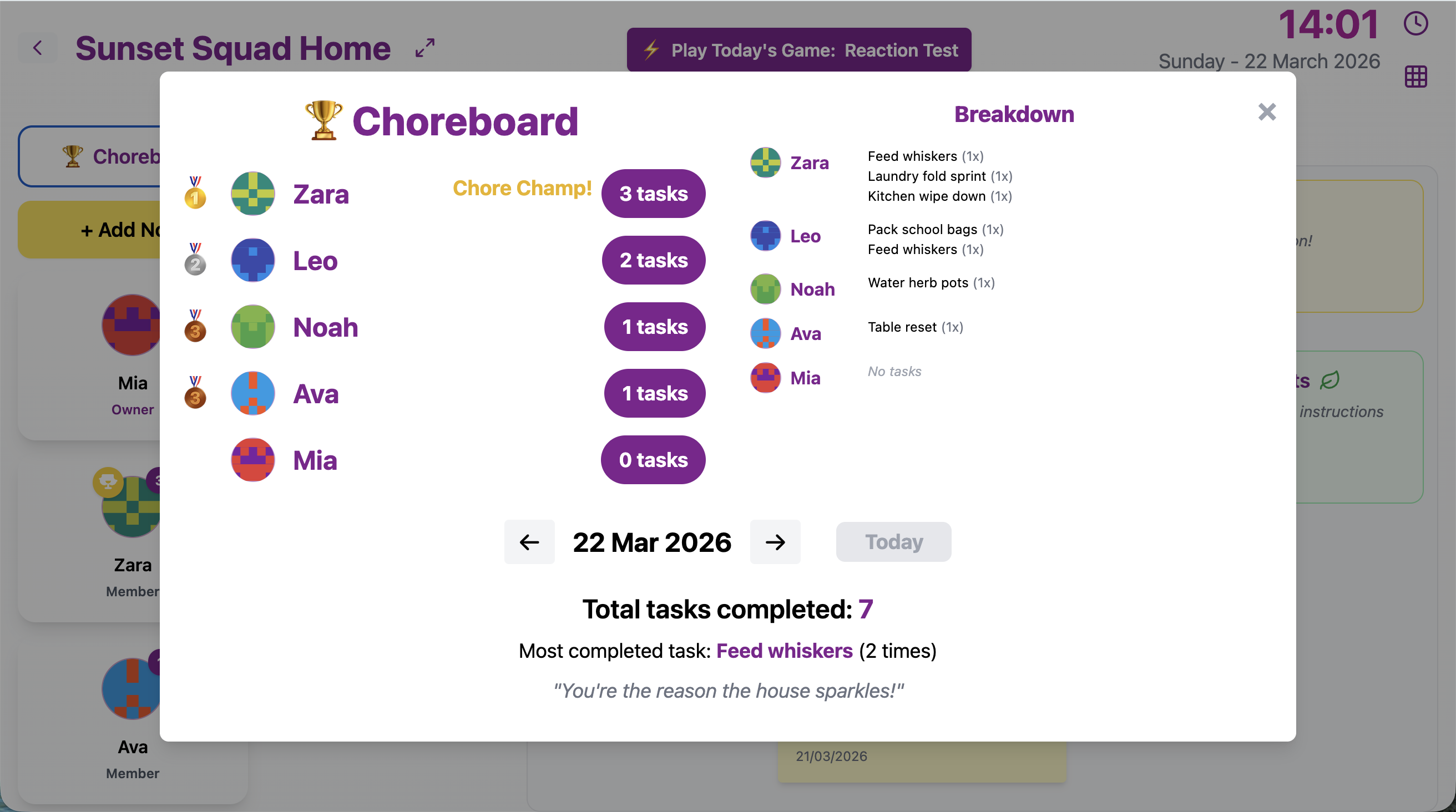
A scoreboard works best when it feels friendly, visible, and low pressure.
Expect the reset wobble
The first week of a new chore habit is rarely smooth. Someone forgets. Someone negotiates. Someone taps the wrong thing or claims that “put away laundry” cannot apply because the laundry is “still thinking.”
That is normal. Treat the first week as practice, not proof that the idea has failed.
When the wobble happens:
- Repeat the routine calmly.
- Point back to the visible list.
- Make the next step smaller.
- Praise any honest attempt.
- Adjust chores that are too vague or too big.
Do not redesign the whole system after one bad Tuesday. Most household routines need a few tries before they feel ordinary.
A simple first-week plan
If you want a low-drama way to begin, try this for one week:
- Choose five household jobs. Pick chores that are clear, repeatable, and actually useful.
- Put them somewhere visible. Paper, whiteboard, tablet, or shared chore app all work.
- Choose one daily reset time. After dinner is often easier than the morning rush.
- Let each person pick one job. Choice helps reduce the “why me?” energy.
- Mark jobs done immediately. A tick, sticker, tap, or moved magnet is enough.
- End with one sentence of thanks. Keep it specific and calm.
At the end of the week, ask two questions:
- “Which chore felt easiest to remember?”
- “Which one needs changing?”
That tiny review makes the system feel like something the household owns together, not something dropped from above.
Where Chorish can fit, gently
You do not need an app to introduce chores well. A paper chart and a kind tone can go a long way.
If your family does like a digital shared board, Chorish is one free, no-sign-up option designed for visible household chores, avatars, a friendly Choreboard, and quick mini-games when a small breather helps. It works best when used as the quiet helper in the room, not as the boss of the room.
For a deeper look at visible progress, read Chore Charts vs. a Live Scoreboard. If your family needs a little more playfulness around the whole thing, 5 Ways Chorish Turns Chore Chaos into Family Fun is a good next read.
Final thought
Introducing chores without a family fight is not about finding the perfect chart, the perfect phrase, or the perfect reward. It is about making the next helpful action small, visible, and ordinary.
Start tiny. Keep the list where everyone can see it. Praise effort before perfection. Use teamwork language. Adjust what does not work.
If the first attempt is messy, congratulations: you are doing family life, not running a showroom. Reset, try again tomorrow, and remember that one cleared plate still counts.
Questions about Chorish are covered in the FAQ, but the bigger principle works anywhere: chores go better when everyone can see the plan and nobody feels like they are being dragged into a lecture.