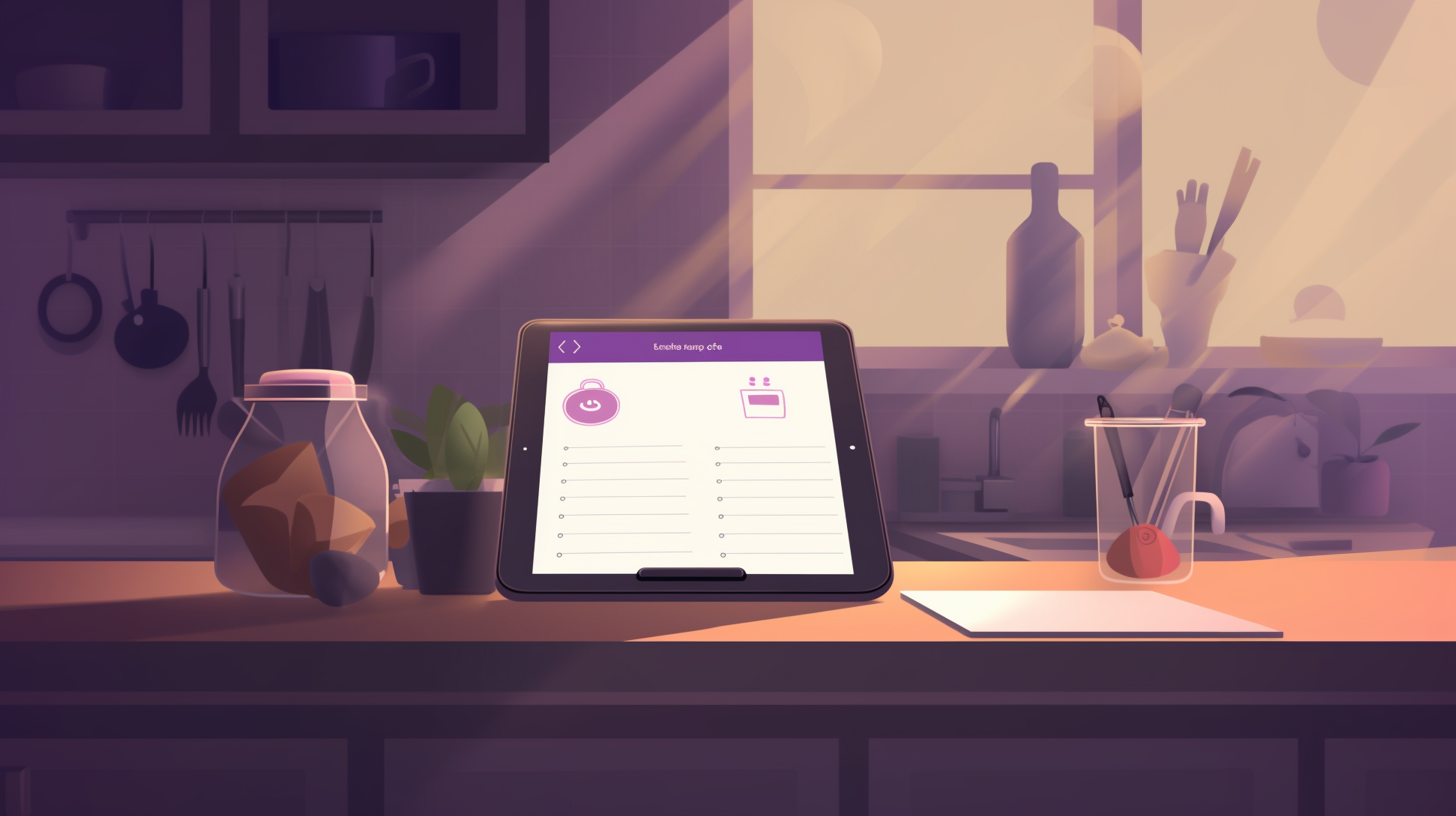
Nagging is one of those household habits nobody really enjoys, yet it sneaks in anyway.
You ask someone to put their shoes away. Then you ask again. Then you ask in a voice that sounds suspiciously like your own parent. Ten minutes later, the shoes are still performing modern art in the hallway and everyone feels slightly grumpy about footwear.
The problem is not always laziness. Often, chores are simply too invisible. The list lives in one adult’s head, the reminder arrives only when someone is already annoyed, and the child or roommate on the receiving end hears, “You forgot again,” instead of, “Here is the next small thing.”
Making chores visible changes the tone. A shared list, a predictable routine, and a clear way to mark progress can reduce the need for constant reminders. It will not magically make laundry fold itself, which is a rude oversight by the universe, but it can make household help feel less like a daily debate.
Here is how to make chores easier to see, easier to start, and much less dependent on repeating yourself.
Why nagging happens in the first place
Nagging usually grows in the gap between what one person is tracking and what everyone else can see.
In many homes, the chore system looks something like this:
- One adult notices everything that needs doing.
- Everyone else notices the snack cupboard.
- The adult gives reminders.
- The reminders are ignored, delayed, or misunderstood.
- The adult gets frustrated and repeats the reminder with extra seasoning.
This is not a character flaw. It is a visibility problem.
If chores only exist as spoken instructions, they disappear as soon as the conversation ends. If the list only lives on a parent’s phone, kids cannot build the habit of checking it. If a roommate agreement is buried in a group chat from six Tuesdays ago, nobody is going to scroll back before taking out the bins.
A visible chore system gives the household a shared reference point. Instead of one person carrying the mental load and broadcasting reminders, the list sits where everyone can check it.
That shift matters because the reminder becomes less personal. “The board says the table still needs wiping” usually lands better than “How many times do I have to ask you to wipe the table?”
Same chore. Completely different weather system.
Put the chore list where life already happens
The best chore list is not necessarily the prettiest one. It is the one people actually see.
Choose a shared place your household naturally passes during the day:
- Kitchen counter
- Fridge door
- Breakfast table
- Hallway near shoes and bags
- Family tablet stand
- Shared desk or common room in a flat
The goal is to make the list part of the room, not a secret document managed by one tired project manager in slippers.
For some families, a paper list works beautifully. For others, a whiteboard is easier to update. Many households like a shared tablet because it can show the current chore list, who has pitched in, and what has already been completed without needing stickers, pens, or the one magnet that always falls behind the radiator.
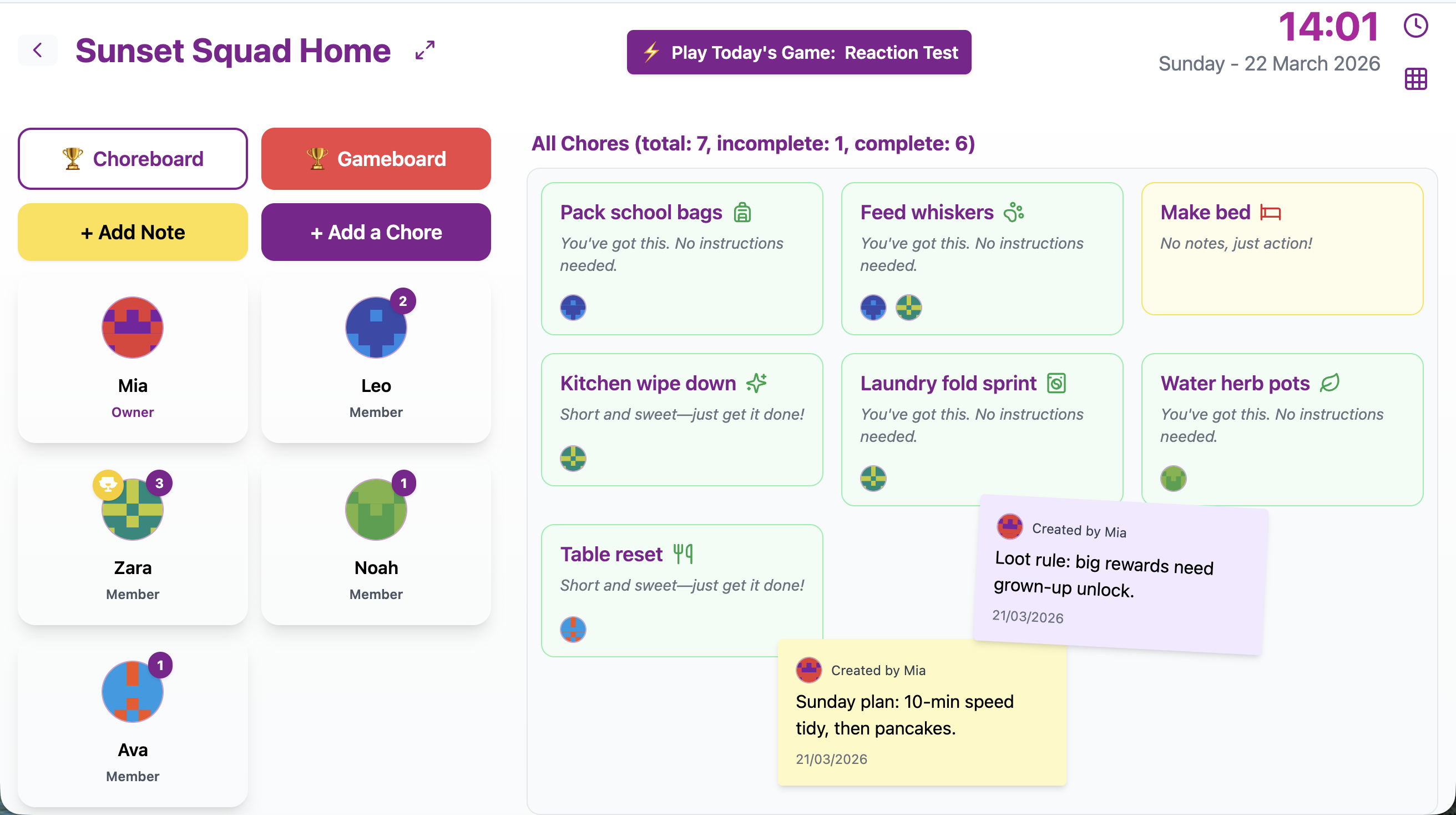
A shared dashboard makes chores part of the room instead of another thing for one person to remember.
If you use Chorish, the home dashboard can sit on a shared device with chores, sticky notes, and member avatars visible at a glance. But the principle works with any system: place the list where people already look.
Replace repeated reminders with routine cues
A reminder feels less like nagging when it is attached to a routine instead of a mood.
“Can you clear your plate?” after dinner is easier to accept than a surprise complaint two hours later. “Check the board before screens” is clearer than “Why is nobody helping?” shouted from another room while holding a rogue sock.
Try pairing chores with moments that already happen:
| Routine moment | Small chore cue |
|---|---|
| After breakfast | Clear plate, put cup by the sink, check school bag area |
| After school | Shoes away, lunchbox emptied, one shared-space reset |
| Before screens | One two-minute chore from the visible list |
| Before bed | Clothes in basket, books back, floor cleared |
| Weekend morning | Pick one bigger household job together |
The routine does some of the reminding for you. Over time, “after dinner means clear plates” becomes easier than inventing a fresh instruction every night.
Keep the cue short. Children and busy adults alike can tune out when reminders become mini-lectures. A simple phrase works better:
- “Check the board.”
- “Pick one quick win.”
- “What still needs doing?”
- “One job before screens.”
- “Let’s do a two-minute reset.”
None of these phrases accuse anyone. They point attention back to the shared system.
Use positive framing, not courtroom language
When chores are invisible, reminders often become evidence in a case nobody wanted to attend.
“You never help.”
“I always have to ask.”
“Your brother has done more than you.”
These phrases are understandable on a hard day, but they tend to make people defensive. The conversation becomes about fairness, blame, or whether “never” is technically accurate. Spoiler: children are surprisingly committed to debating adverbs.
Positive framing keeps the focus on the next helpful action:
- “The kitchen is nearly reset. Who wants the last quick job?”
- “Thanks for clearing your plate. Can you tap it done?”
- “The hallway needs one helper.”
- “Let’s see what the board says before we start a game.”
- “That was a small job, but it counts.”
You are not pretending chores are thrilling. You are making them feel manageable. The tone says, “We are a household that helps,” rather than, “You are in trouble because I noticed something first.”
This is especially useful when introducing chore routines for kids. A calm system plus calm language gives children a better chance to participate without feeling ambushed.
Make “done” obvious
One reason people ignore chores is that the finish line is fuzzy.
“Tidy the living room” could mean five different things depending on who you ask. To one person, it means putting cushions back. To another, it means museum-level restoration of the entire downstairs. To a child, it may mean standing in the room and feeling overwhelmed by objects.
Clear chores are easier to complete and easier to mark done.
Instead of “tidy up,” try:
- Put shoes by the door.
- Put toys in the basket.
- Clear plates from the table.
- Wipe the table after snack.
- Put dirty clothes in the laundry basket.
- Take recycling to the correct bin.
- Put books back on the shelf.
When a task has a visible ending, the person doing it gets a small sense of completion. That matters. It turns chores from a vague cloud of obligation into a series of finishable actions.
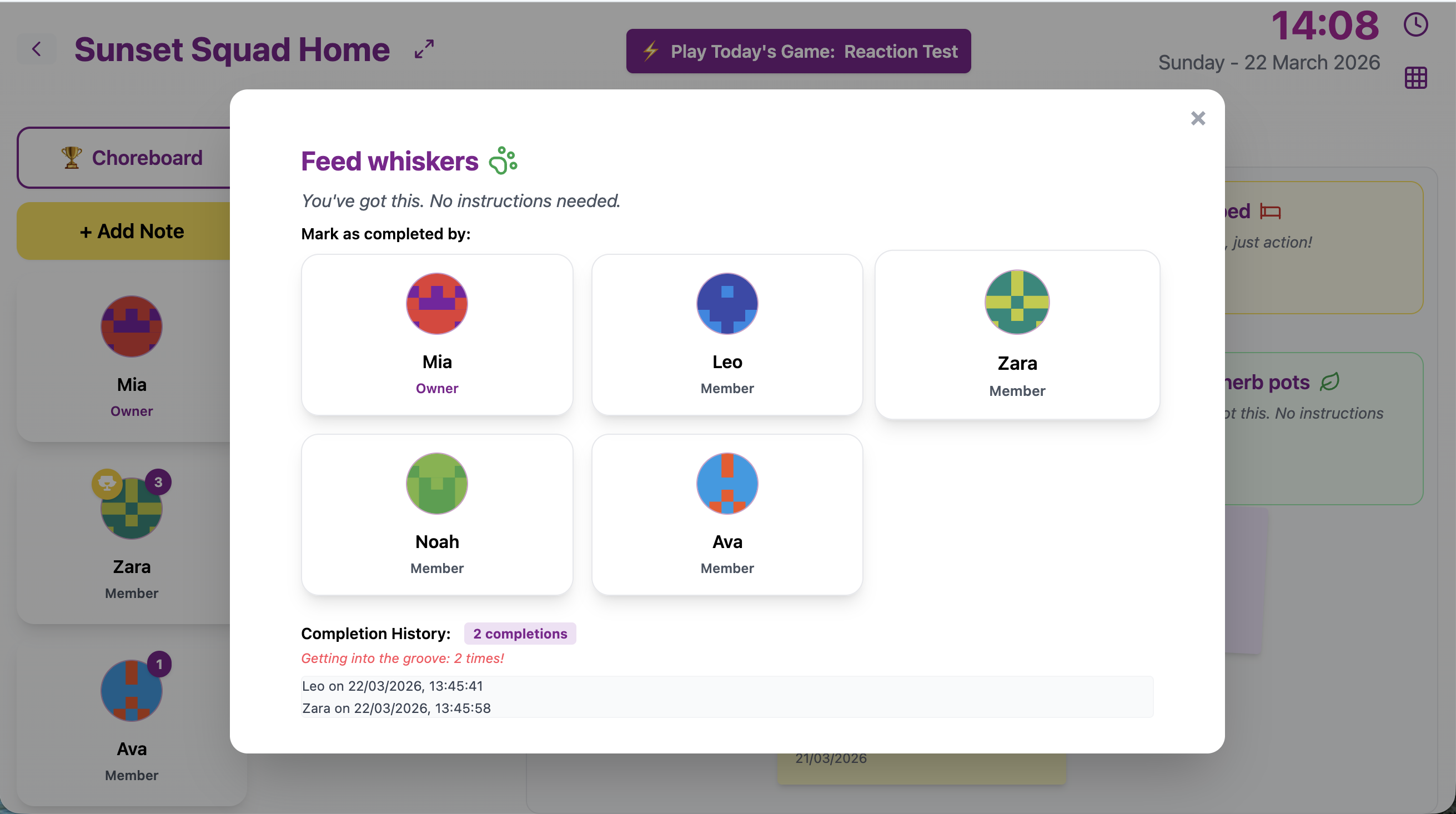
A clear completion step helps the chore feel finished, not just mentioned.
On Chorish, family members can tap their avatar and mark a chore complete, which makes the feedback immediate. On paper, a tick, sticker, or crossed-off line can do the same job. The important part is that completion is visible.
Add sticky notes for the things that do not fit the main list
Not every household reminder deserves to become a formal chore.
Some things are temporary:
- “PE kit tomorrow”
- “Use the last bananas”
- “Library books by the door”
- “Bin day”
- “Do not forget the plant on the windowsill, it has started looking dramatic”
These reminders can clutter a chore list if you mix everything together. A separate sticky note, whether physical or digital, helps keep temporary household nudges visible without turning the main list into a novel.
Sticky notes are also softer than spoken reminders. A note on the dashboard or fridge can say, “This matters today,” without following anyone around the house.
Use them sparingly. If every surface has twelve urgent notes, the household will simply develop note blindness. A few well-placed reminders work better than a wallpaper of instructions.
Let avatars and scores carry some of the feedback
Children often respond well to seeing their own progress. So do adults, even if we pretend to be above such things and then check step counts like tiny athletes.
Avatars, checkmarks, scores, and lighthearted rankings can make effort visible without needing a speech every time. The key is to keep the tone friendly. A shared board should encourage participation, not make anyone feel publicly shamed for losing to the dishwasher.
Good scoreboard language sounds like:
- “Nice, you moved up after that quick job.”
- “The board shows the table is done. Thank you.”
- “Looks like everyone has helped today.”
- “One more chore and the kitchen is in good shape.”
Less helpful scoreboard language sounds like:
- “Why are you last?”
- “Your sister is winning, so try harder.”
- “You only helped because of the points.”
The first set notices effort. The second turns the board into pressure. If competition starts causing stress, dial it back and focus on teamwork for a while. Our guide to chore charts vs. a live scoreboard has more on using visibility without making the household feel like a league table.
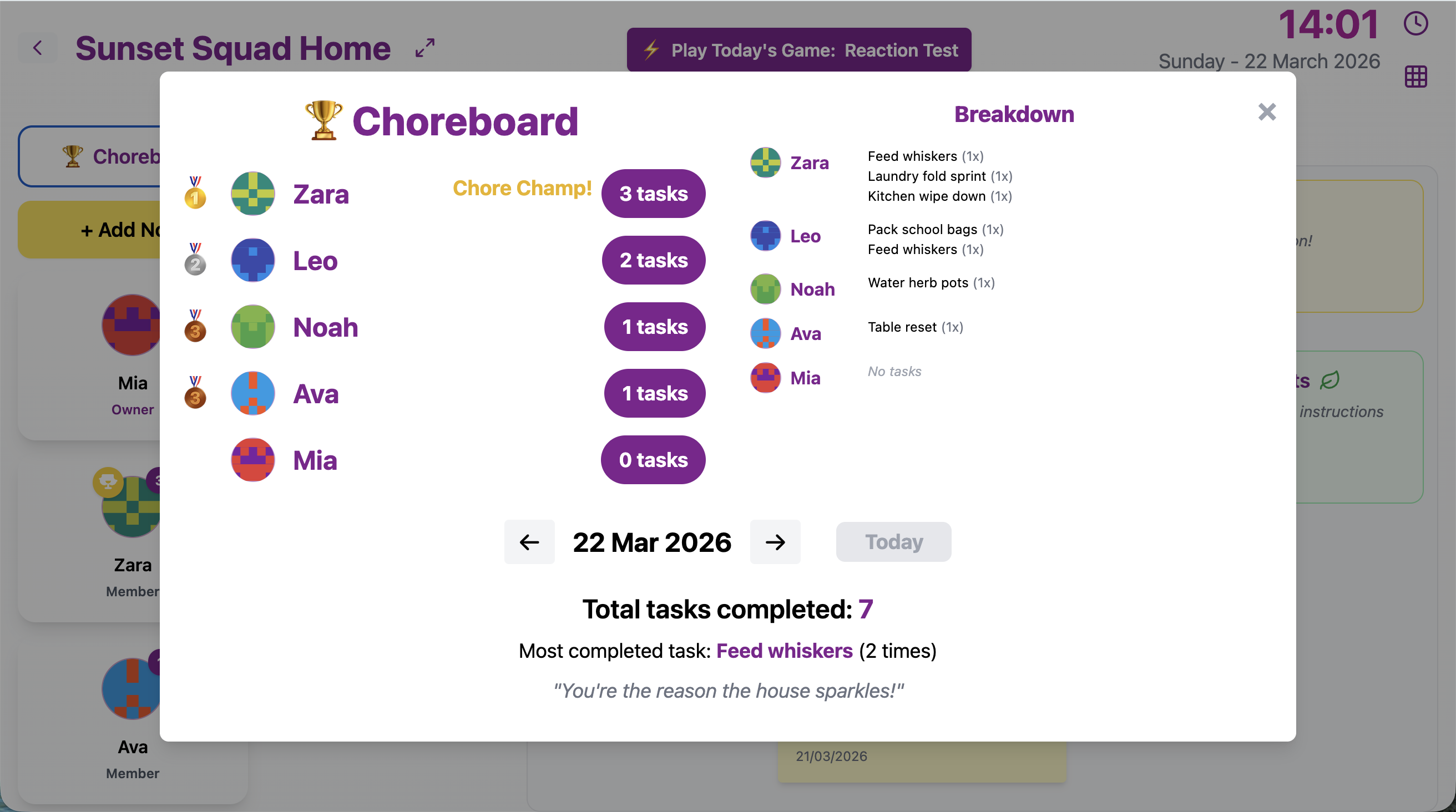
A Choreboard can make progress visible, as long as the family keeps the competition light.
Use games as a finish-line treat, not a bargaining chip
A quick game after a chore can be a nice release valve. It gives children a reason to finish a small task and creates a shared moment that is not another reminder.
The trick is to keep it light:
- “Finish one job, then we can do the daily game.”
- “Let’s clear the table and then try Word Scramble.”
- “One quick chore each, then a two-minute game break.”
Try not to turn every chore into a negotiation. If a game becomes the only reason anyone helps, the routine can get wobbly. But as an occasional rhythm, a short playful break can make the household feel less like a task factory.
Chorish includes rotating daily games such as Quick Quiz, Emoji Riddle, Memory Flip, Word Scramble, and Spot the Difference. They sit next to the chore tools so the break still feels connected to the shared household flow. For more on that balance, see why a quick game after a chore is a break, not a distraction.
A simple no-nag reset for this week
If your current system relies mostly on reminders from one exhausted person, start small. You do not need a complete domestic constitution. You need a list people can see and a rhythm they can repeat.
Try this for one week:
- Choose five chores that happen often.
- Put them in a shared visible place.
- Make each chore specific enough to finish.
- Pick one routine cue, such as after dinner or before screens.
- Use the phrase “check the board” instead of repeating individual instructions.
- Notice effort quickly, even when it is imperfect.
- Review what worked at the end of the week.
If something causes friction, shrink it. “Clean your room” might become “laundry in basket.” “Help with dinner” might become “put forks on the table.” Small visible jobs build trust faster than giant vague ones.
You can also pair this reset with age-aware chore ideas from our guide to age-appropriate chores for kids, especially if younger children need simpler tasks or older kids are ready for more independence.
The real goal: fewer reminders, more shared ownership
Making chores visible is not about creating a perfect household. Perfect households are mostly found in furniture catalogues and immediately before guests arrive.
The goal is simpler: reduce the number of times one person has to carry, remember, and repeat the whole list.
When chores are visible:
- Kids can see what needs doing.
- Adults can point to the system instead of delivering speeches.
- Roommates have a shared reference point.
- Progress feels clearer.
- Small jobs are easier to notice.
- Nagging has less room to grow.
That is a kinder setup for everyone.
If you want a free, browser-based way to put this into practice, try Chorish. It gives your household a shared dashboard, avatars, sticky notes, a Choreboard, and optional daily games without needing a sign-up. A paper chart or whiteboard can work too; the main thing is choosing a system your family will actually see.
For questions about how Chorish works, visit the FAQ. And if you are still in the early stages of getting everyone on board, start with how to introduce chores without a family fight before the shoes begin their next hallway exhibition.